There are places in Turkey where history feels preserved.
And then there are places like Miletus, where history is still
breathing.
We arrived in Miletus expecting grand ruins — and yes, they are there. But
what we did not expect was the quiet rhythm of rural life moving gently between
2,000-year-old stones.
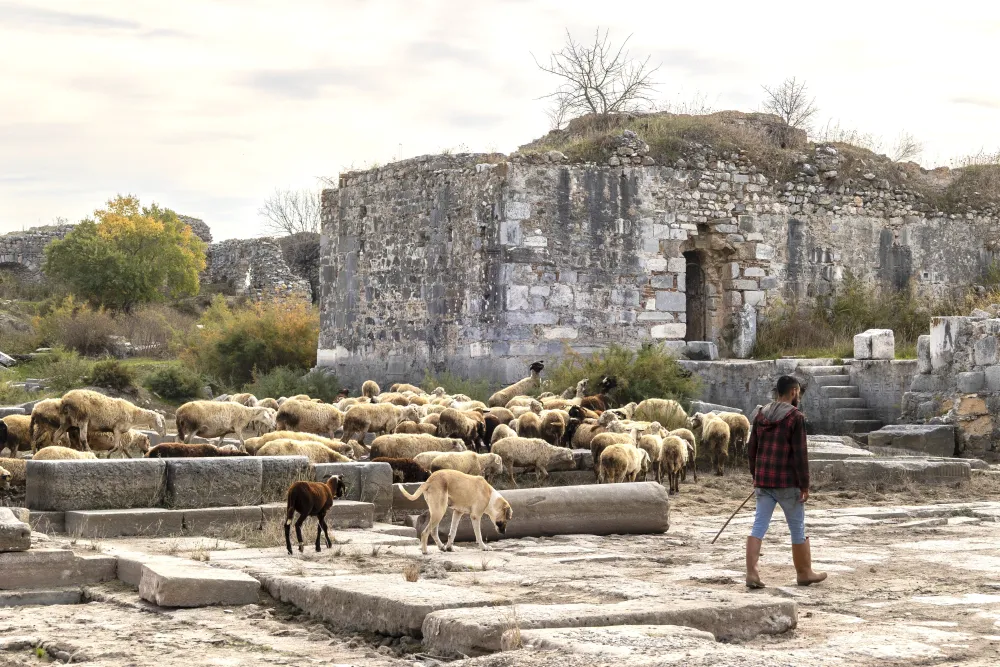
Before we even stepped toward the theater, we saw him.
A shepherd.
He was guiding his flock slowly across the ancient grounds — sheep moving
in soft waves between marble blocks, a loyal shepherd dog circling carefully,
and behind them, the weathered walls of what was once one of the greatest
cities of the ancient world.
It was the kind of moment that makes you stop walking.
The City That
Shaped Western Thought
Miletus was not just another ancient settlement. It was once one of the
most powerful Greek cities on the western coast of Anatolia.
This is the birthplace of Thales, one of the very first philosophers of the
Western world. A man who dared to ask, “What is everything made of?” — and
began searching for answers not in mythology, but in observation.
Standing here, you realize something extraordinary:
While ideas that shaped Western science were being born in this city, the
land itself was already timeless.
Today, the grand theater still rises above the plains. The Baths of
Faustina remain dignified in their silence. The grid-planned streets —
revolutionary for their time — whisper stories of merchants, sailors, thinkers,
and travelers who once passed through this harbor city.
And yet…
There are sheep grazing where philosophers once debated.
The Shepherd
Among the Ruins
As we walked deeper into the site, the shepherd moved calmly across the
stone pathways.
His boots made a dull sound against ancient slabs.
His dog — alert, disciplined — guided the flock gently away from the fragile
ruins.
The sheep passed between broken columns that once framed civic buildings.
No rush. No performance. Just daily life.
That moment perfectly captured what makes Miletus so special:
This is not a museum behind glass.
This is Anatolia — layered, alive, continuous.
The same soil that once supported Ionian philosophers now feeds shepherds
and olive trees.
For many travelers, this becomes the most unexpected highlight. Not just
the scale of the theater. Not only the history.
But witnessing how naturally modern rural life coexists with 2,500 years of
civilization.
Why Miletus
Feels Different
Unlike more crowded ancient sites, Miletus often feels spacious and quiet.
You can stand alone in the theater and imagine ships once anchored at its
harbor (now far inland due to centuries of silt from the Meander River).
There is something deeply authentic here.
No staged folklore.
No forced storytelling.
Just wind, stone, and sometimes… a shepherd crossing the stage of history.
Visiting
Miletus Today
Miletus is located in western Turkey, near the Aegean coast, often combined with:
-Priene
-Didyma (Temple of Apollo)
-Ephesus
And if we’re lucky…
We might meet that shepherd again.